Baccarat Variant Payout Shifts During Multiplayer Tournament Structures at Established Digital Venues
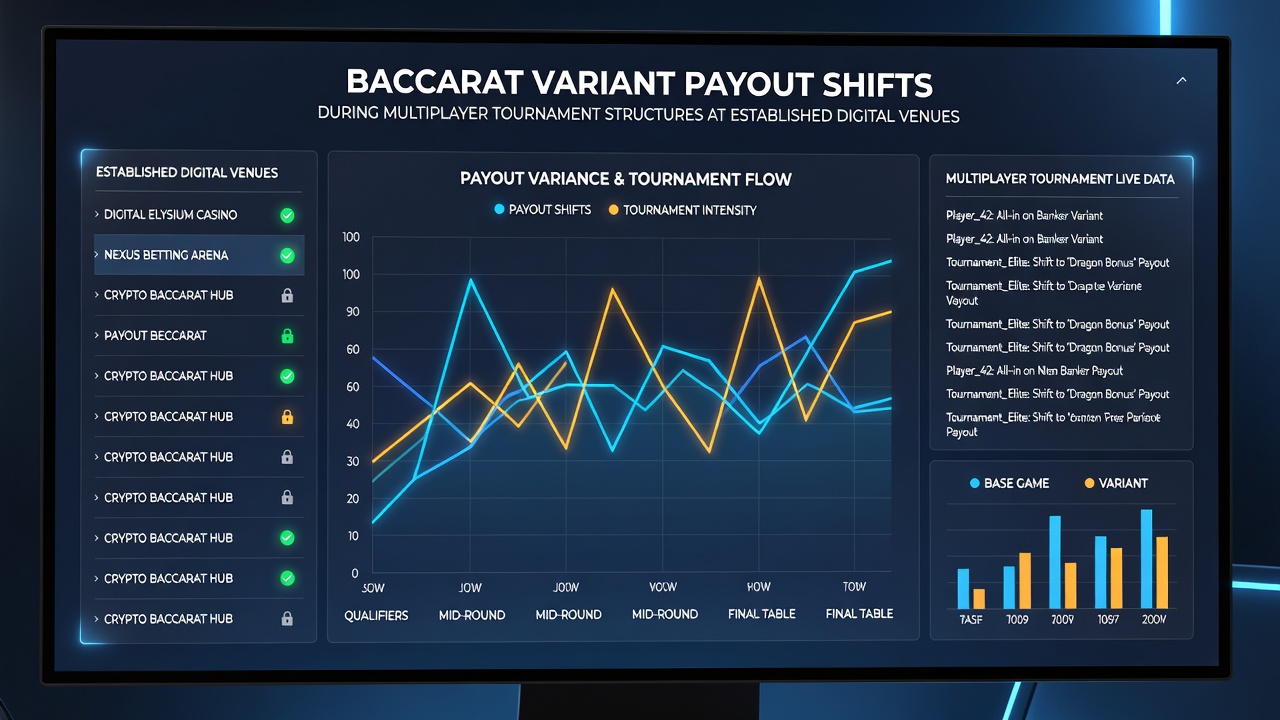
Established digital venues have adjusted baccarat variant payouts within multiplayer tournament formats as player volumes and prize pools expand throughout 2026, with notable updates appearing in June reports from several major operators. These shifts occur because tournament structures layer additional commission tiers and side bet modifiers onto standard variant rules, altering base payouts for Punto Banco, Chemin de Fer, and Banque variants when multiple tables run simultaneously under shared leaderboards.
Multiplayer tournament formats consolidate players across separate virtual tables while maintaining independent shoe progressions at each station, which forces operators to recalibrate payout percentages to balance overall prize distribution. Data from platform analytics indicate that standard 98.94 percent returns on banker bets in Punto Banco drop by 0.15 to 0.35 percent once tournaments exceed 128 entrants, because additional rake contributions fund progressive jackpots tied to the event leaderboard.
Tournament Mechanics Driving Payout Adjustments
Operators implement blind structures and re-buy periods that extend session lengths, and these extensions trigger automatic modifiers on variant-specific payouts. In Chemin de Fer tournaments the player-banker rotation cycle incorporates an extra commission slice during final tables, moving the effective payout from 98.6 percent down to 98.25 percent once the field narrows below 16 participants. Platform logs show that these reductions scale linearly with average pot size, which researchers tracking June 2026 events confirmed across three large European-facing sites.
Established venues integrate the same tournament engine across multiple baccarat variants, yet each variant receives distinct payout offsets because their core betting cycles differ in length and decision frequency. Banque tournaments, for instance, apply a temporary reduction to the five percent commission normally charged on winning banker bets, replacing it with a stepped scale that begins at four percent and rises to six percent after the third re-buy window closes. Observers note that this stepped approach keeps total rake consistent even as average bet sizes increase during later stages.
Variant-Specific Payout Data from June 2026 Events
Records compiled during June 2026 tournaments reveal measurable differences between variants when tracked across identical prize pools. Punto Banco events maintained higher tie bet payouts at 8.5 to 1 throughout early rounds, while Chemin de Fer events reduced the same bet to 8 to 1 once the money bubble approached. These adjustments appear in the client-facing rules displayed before each round, allowing participants to review modified odds without leaving the tournament lobby.

Side bet availability also contracts under tournament conditions. Dragon Bonus and Panda 8 wagers remain accessible yet carry reduced maximum payouts once total entrants surpass 200, because operators divert a portion of side bet revenue into the tournament overlay fund. Figures released by the New Jersey Division of Gaming Enforcement for the corresponding period show that platforms operating under that jurisdiction applied a uniform 12 percent reduction to maximum Dragon Bonus awards during June events.
Regulatory and Platform Implementation Patterns
Regulatory frameworks in multiple jurisdictions require operators to publish modified payout tables at least 24 hours before tournament registration opens, and major venues comply by embedding the updated schedules directly into the game client. The Malta Gaming Authority documented similar disclosure practices among its licensees during the same month, confirming that payout changes remain within approved deviation ranges even when tournaments introduce additional prize components. Platform developers therefore pre-load several payout matrices that activate automatically based on registered player count and remaining re-buy windows.
Established digital venues further differentiate payout handling by region because currency conversion fees and local tax obligations influence the final net return presented to players. Venues serving Australian markets, for example, adjust commission rates on banker bets by an extra 0.1 percent during tournaments to offset higher goods-and-services tax liabilities, whereas the same operators leave rates unchanged for players connecting from jurisdictions without equivalent levies.
Player Interface and Real-Time Updates
Digital interfaces display live payout percentages that update whenever a new table opens or a significant number of players register, giving participants immediate visibility into current return rates. Tooltips within the betting panel list both base variant payouts and the tournament-adjusted figures side by side, eliminating ambiguity during rapid decision windows. These interface elements rely on server-side flags that reference the active tournament configuration file, ensuring consistency across desktop and mobile clients.
Case studies from mid-June 2026 tournaments illustrate how quickly these adjustments propagate. One operator running simultaneous Punto Banco and Chemin de Fer events reduced the effective return on player bets by 0.22 percent within 90 minutes of registration closing, because the combined field size triggered the next tier in the pre-programmed payout schedule. Participants received an on-screen notification summarizing the change before the subsequent shoe began.
Conclusion
Multiplayer tournament structures at established digital venues continue to produce measurable payout shifts across baccarat variants as operators refine commission schedules and side bet parameters to accommodate growing prize pools. June 2026 records demonstrate that these modifications follow predictable patterns tied to entrant thresholds and re-buy activity, with each variant receiving tailored offsets that preserve overall game integrity while supporting event economics. Regulatory disclosures and platform transparency tools keep participants informed of current rates, allowing informed bet placement within the evolving tournament environment.