Baccarat's Tie Bet Mechanics and Their Impact on Overall Casino Payout Distributions

Baccarat tie bets operate under precise rules that determine when the hand ends in a draw and how winnings distribute among participants. The tie occurs when the player and banker hands reach identical point totals after all cards have been dealt according to standard drawing protocols. This outcome triggers an 8-to-1 payout in most casino environments, although select venues adjust the ratio to 9-to-1 under specific house policies.
Core Rules Governing Tie Resolutions
The mechanics begin with the initial two cards dealt to each side, where point values range from zero to nine based on the face values of the cards modulo ten. When totals match at this stage, play concludes immediately and the tie bet wins without further draws. Should one side require a third card under the established guidelines, the new total must still equal the opposing hand for the tie to stand. Observers note that these rules remain consistent across most international tables, yet minor regional variations appear in how certain third-card scenarios resolve when both hands reach eight or nine.
Probability Structures and Frequency Data
Statistical records compiled by regulatory bodies show that tie outcomes appear in approximately 9.5 percent of all resolved hands. This frequency directly shapes the expected value calculations that casinos apply when setting betting limits and commission structures. Data from the Nevada Gaming Control Board reveals consistent patterns across thousands of shoes tracked annually, with tie occurrences clustering in predictable intervals that influence table minimums during peak hours.
What's interesting is how the 8-to-1 payout ratio interacts with this low probability to create a house edge exceeding 14 percent on tie wagers alone. The elevated edge stems from the mathematical gap between actual occurrence rates and the compensation offered to players. Researchers at gaming analysis centers have documented that this disparity contributes measurable shifts in overall payout distributions whenever tie volume increases during extended play sessions.
Influence on Broader Casino Revenue Flows
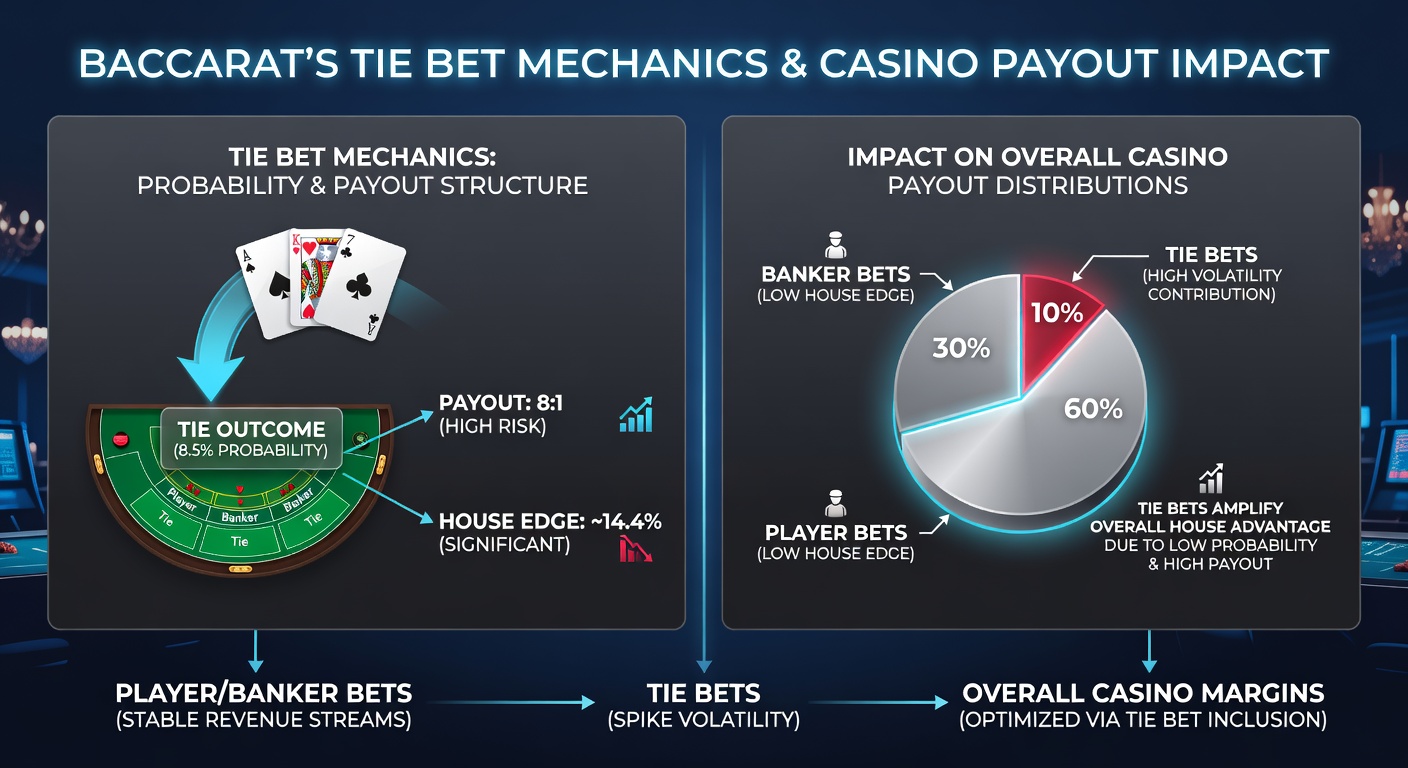
Tie bet activity alters the balance of money returned to players versus retained by the house in measurable ways. When tie wagers represent a larger share of total bets placed at a table, the higher house edge on those bets accelerates revenue accumulation for the operator. Figures released in May 2026 from multiple Asian gaming jurisdictions indicate that properties adjusting tie payout ratios observed corresponding changes in daily drop percentages without affecting player or banker bet volumes.
Casino accounting systems track these distributions through segregated ledgers that separate tie proceeds from standard bets. The separation allows operators to monitor how tie frequency affects aggregate hold percentages across entire properties. One study conducted by an Australian research institute found that tables promoting tie side bets through visual displays experienced a 3 percent uptick in tie participation rates, which in turn raised the combined house edge for the game by nearly one full percentage point over a six-month period.
Regional Variations in Tie Bet Implementation
European casinos sometimes employ modified tie rules that incorporate additional side payouts for specific total combinations such as three-of-a-kind ties. These adjustments create localized payout distributions that differ from North American or Asian standards. Canadian provincial regulators have published reports detailing how such variations affect compliance audits and tax calculations tied to gross gaming revenue.
Operators in Macau maintain strict adherence to 8-to-1 tie payouts while publishing monthly transparency reports that break down bet-type contributions to overall revenue. The reports demonstrate that tie bets, despite lower volume, account for disproportionate shares of theoretical win due to their elevated house edge. This pattern holds steady even as total table counts fluctuate with seasonal tourism cycles.
Conclusion
Baccarat tie bet mechanics remain a fixed component within the game's payout architecture, and their statistical properties continue to shape how casinos allocate returns across all wager categories. Regulatory data from diverse jurisdictions confirms that tie frequency and payout ratios exert consistent pressure on aggregate hold percentages regardless of geographic location or operational scale. Those who analyze gaming performance metrics recognize that accurate modeling of tie outcomes supports more precise forecasting of long-term revenue distributions.